
LLM Powered Autonomous Agents
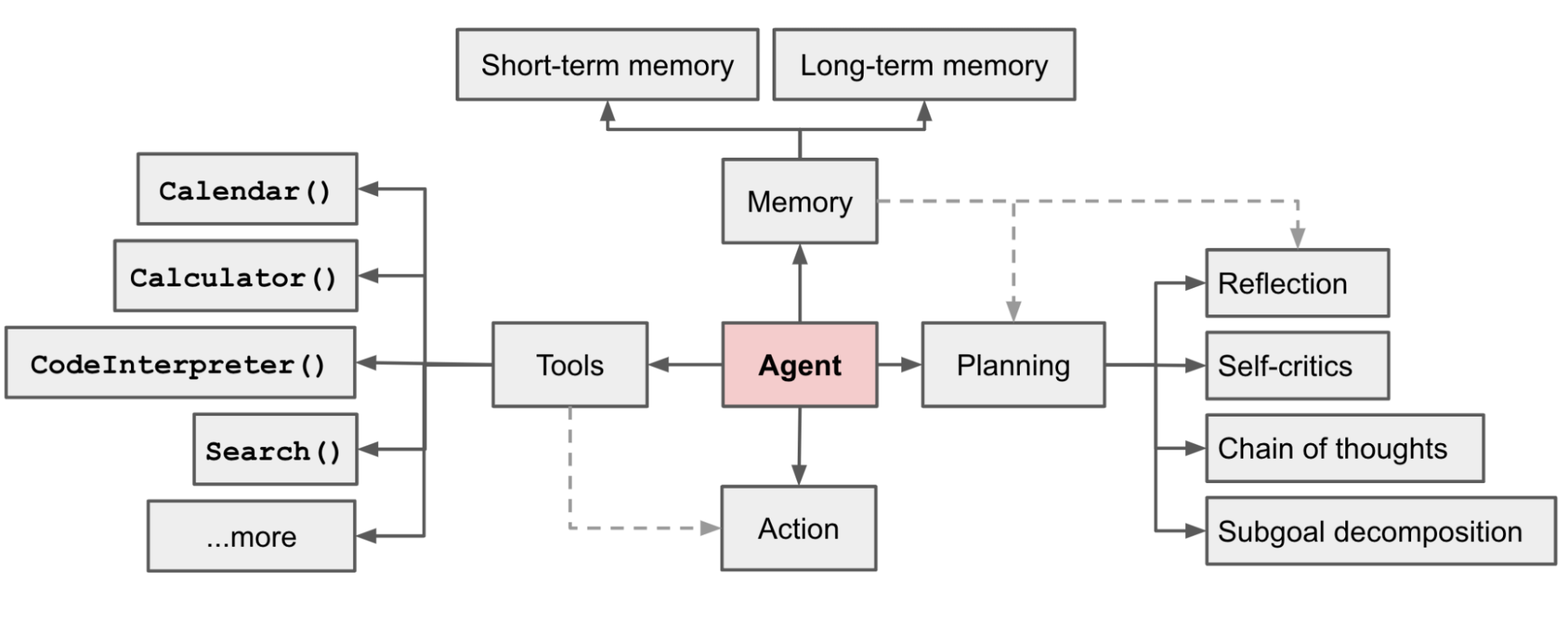
Building agents with LLM (large language model) as its core controller is a cool concept. Several proof-of-concepts demos, such as AutoGPT, GPT-Engineer and BabyAGI, serve as inspiring examples. The potentiality of LLM extends beyond generating well-written copies, stories, essays and programs; it can be framed as a powerful general problem solver.
Agent System Overview
In a LLM-powered autonomous agent system, LLM functions as the agent’s brain, complemented by several key components:
- Planning
- Subgoal and decomposition: The agent breaks down large tasks into smaller, manageable subgoals, enabling efficient handling of complex tasks.
- Reflection and refinement: The agent can do self-criticism and self-reflection over past actions, learn from mistakes and refine them for future steps, thereby improving the quality of final results.
- Memory
- Short-term memory: I would consider all the in-context learning (See Prompt Engineering) as utilizing short-term memory of the model to learn.
- Long-term memory: This provides the agent with the capability to retain and recall (infinite) information over extended periods, often by leveraging an external vector store and fast retrieval.
- Tool use
- The agent learns to call external APIs for extra information that is missing from the model weights (often hard to change after pre-training), including current information, code execution capability, access to proprietary information sources and more.
Component One: Planning
A complicated task usually involves many steps. An agent needs to know what they are and plan ahead.