Comparing interviews at 8 large tech companies
Hi, this is Gergely with a bonus, free issue of the Pragmatic Engineer Newsletter. In every issue, I cover Big Tech and startups through the lens of senior engineers and engineering leaders. Today, we cover one topic from The Pulse #149. Full subscribers received the below article two weeks ago. To get articles like this in your inbox, every week, subscribe here.
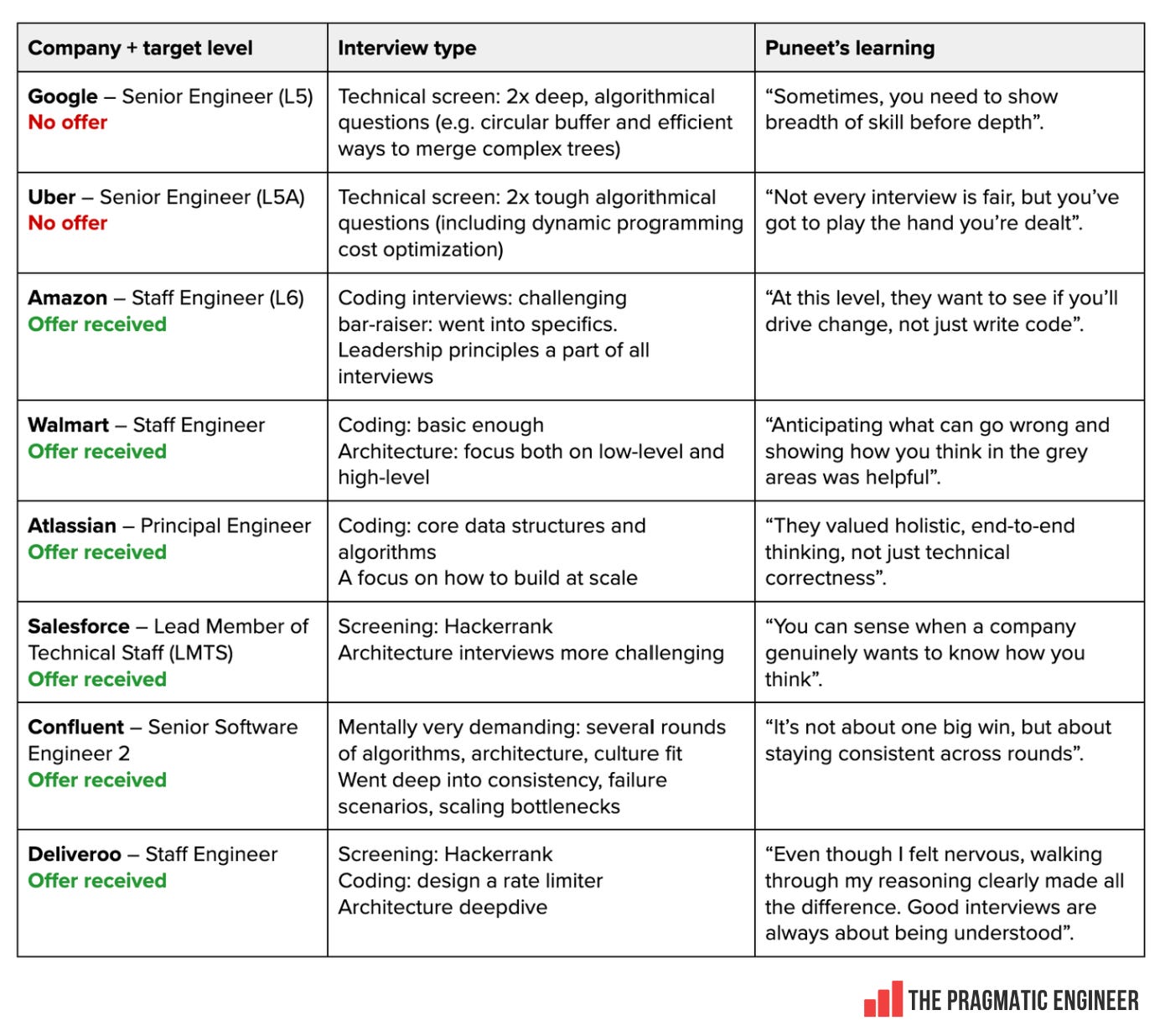
Puneet Patwari recently accepted an offer to join Atlassian as a Principal Software Engineer. In three months, he did more than 60 interviews at 11 companies, he told me – while dropping out of 3 more interview processes after accepting the Atlassian offer, including that of Meta. Following that endeavour, he has compared the interview processes of the largest companies:
A few more observations that Puneet shared with me:
Amazon: the Amazon Hiring Manager round was one of the most unique I ever experienced. We got so engrossed in the discussion that it took 160 minutes instead of the scheduled 60 minutes! We had to take a break in between the interview process.
Atlassian: The leadership craft (LC) & values were two interview rounds which were very crucial in determining that I’ll be levelled at the Principal level. Of course, the Systems Design interview was also key here. Atlassian puts a lot of emphasis on LC for Principal engineers.
Salesforce: the system design round was based on the actual job requirement. It was a migration problem where the interviewer wanted to check if I can own a project end-to-end with customers at the centre of it.
Confluent: when I say it was the most mentally demanding interview, what I mean is how every skill was tested with two interviews! So 2x data structures and algorithms (DSA), 2x System Design 2x behavioural interview rounds.
I cannot stress enough how important behavioural interviews are at the Staff+ levels. Doing well on these interviews were decisive in getting Staff and Principal-level offers. Of course, you needed to do well on coding and systems design: but my sense was that the behavioural parts were make or break for levelling and getting an offer.
A few things stand out to me from Puneet’s account of his interviews at leading tech companies:
- Algorithmical coding interviews are everywhere! For senior+ positions, you need to get really good at these, including challenging topics like dynamic programming. We cover how to perform well in these in the article, How experienced engineers get unstuck in coding interviews
- Interviews are tough, and time consuming. Even after Puneet had offers, no company shortened their process. Puneet had to decline 3 more interviews – including one at Meta – because by the time the interviews would have come around, he already had an offer he had accepted at Atlassian.
- In a tough job market, “top” candidates are still in demand. We’ve covered how challenging the current tech labor market is for jobseekers, but Puneet interviewed at 11 companies and got 6 offers. His applications had to have a lot going for them in order to pass the resume screenings: 10+ years of experience, and working as a Senior Software Engineer at Microsoft. He also showed up really well prepared.
- Bad luck can strike at any time. Puneet’s interview experience at Uber seems to have been a bit unlucky: the interviewer presented as rigid and not open to dialogue. Perhaps they were having a tough day, or wanted to get the interview over with. Or it could be what Steve Yegge describes as the interviewer anti-loop
Congrats to Puneet for accepting the Atlassian position, and thanks for sharing all these learnings!
This was one out of five topics covered in The Pulse #149. The full edition additionally covers:
- New trend: programming by kicking off parallel AI agents. More devs are experimenting with kicking off coding agents in parallel
- ACP protocol. A new protocol built by the Zed team, which tries to make it easier to build AI tooling for IDEs than the MCP protocol allows
- AI security tooling works surprisingly well? AI-powered security tools seem good at identifying security flaws in mature open source projects
- Is AI the only engine of US economic growth? Forty percent of US GDP this year is based on AI-related spend, while 60% of venture capital goes into AI. Hopefully, it won’t end up as a bubble which bursts like in 2001
Read the full issue here, and check out today’s The Pulse here.