One more week to the Logic for Programmers Food Drive
A couple of weeks ago I started a fundraiser for the Greater Chicago Food Depository: get Logic for Programmers 50% off and all the royalties will go to charity.1 Since then, we’ve raised a bit over $1600. Y’all are great!
The fundraiser is going on until the end of November, so you still have one more week to get the book real cheap.
I feel a bit weird about doing two newsletter adverts without raw content, so here’s a teaser from a old project I really need to get back to. Notes on structured concurrency argues that old languages had a “old-testament fire-and-brimstone goto” that could send control flow anywhere, like from the body of one function into the body of another function. This “wild goto”, the article claims, what Dijkstra was railing against in Go To Statement Considered Harmful, and that modern goto statements are much more limited, “tame” if you will, and wouldn’t invoke Dijkstra’s ire.
I’ve shared this historical fact about Dijkstra many times, but recently two separate people have told me it doesn’t makes sense: Dijkstra used ALGOL-60, which already had tame gotos. All of the problems he raises with goto hold even for tame ones, none are exclusive to wild gotos. So
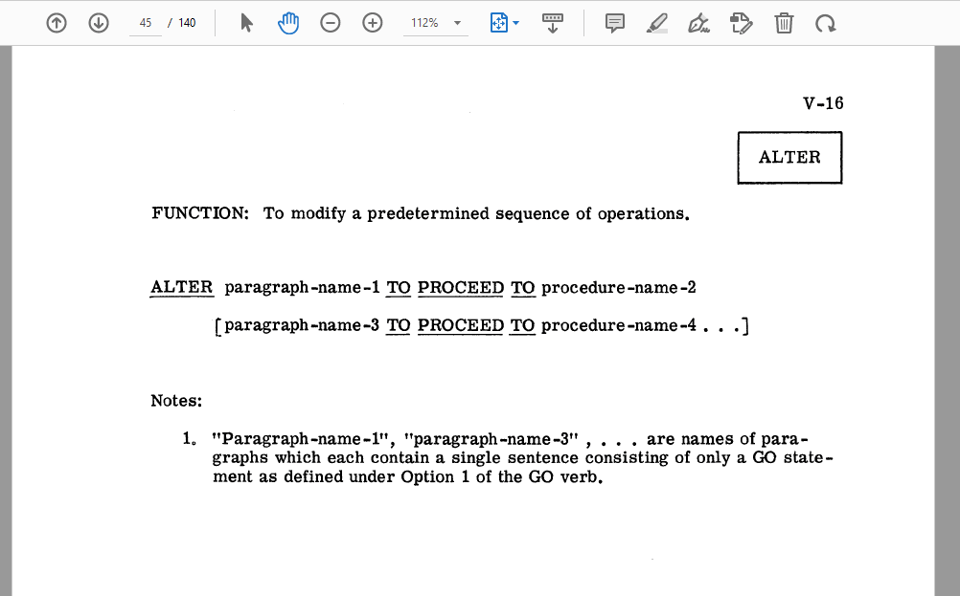
This got me looking to see which languages, if any, ever had the wild goto. I define this as any goto which lets you jump from outside to into a loop or function scope. Turns out, FORTRAN had tame gotos from the start, BASIC has wild gotos, and COBOL is a nonsense language intentionally designed to horrify me. I mean, look at this:
The COBOL ALTER statement changes a goto‘s target at runtime.
(Early COBOL has tame gotos but only on a technicality: there are no nested scopes in COBOL so no jumping from outside and into a nested scope.)
Anyway I need to write up the full story (and complain about COBOL more) but this is pretty neat! Reminder, fundraiser here. Let’s get it to 2k.
-
Royalties are 80% so if you already have the book you get a bit more bang for your buck by donating to the GCFD directly ↩