Welcome, Daily Show Viewers! Learn More About EFF and Privacy’s Defender

About EFF
The Electronic Frontier Foundation is the leading nonprofit defending civil liberties in the digital world. EFF’s work to protect your rights on the internet is supported by over 30,000 members who have joined our mission by donating just this year.
For over 35 years, our lawyers, activists, and technologists have been thinking about the next big thing in tech before anyone else—whether that’s age verification, AI, or Palantir. Whatever causes you fight for, you rely on the internet to do so. And EFF protects the infrastructure of rebellion.
To learn more about our work, follow EFF on social media and subscribe to EFF’s EFFector newsletter below to learn about the ways the internet and online rights are changing and what that means for you. And join EFF to support our fight—because if you use technology, this fight is yours.
Privacy’s Defender: My Thirty Year Fight Against Digital Surveillance, by Cindy Cohn
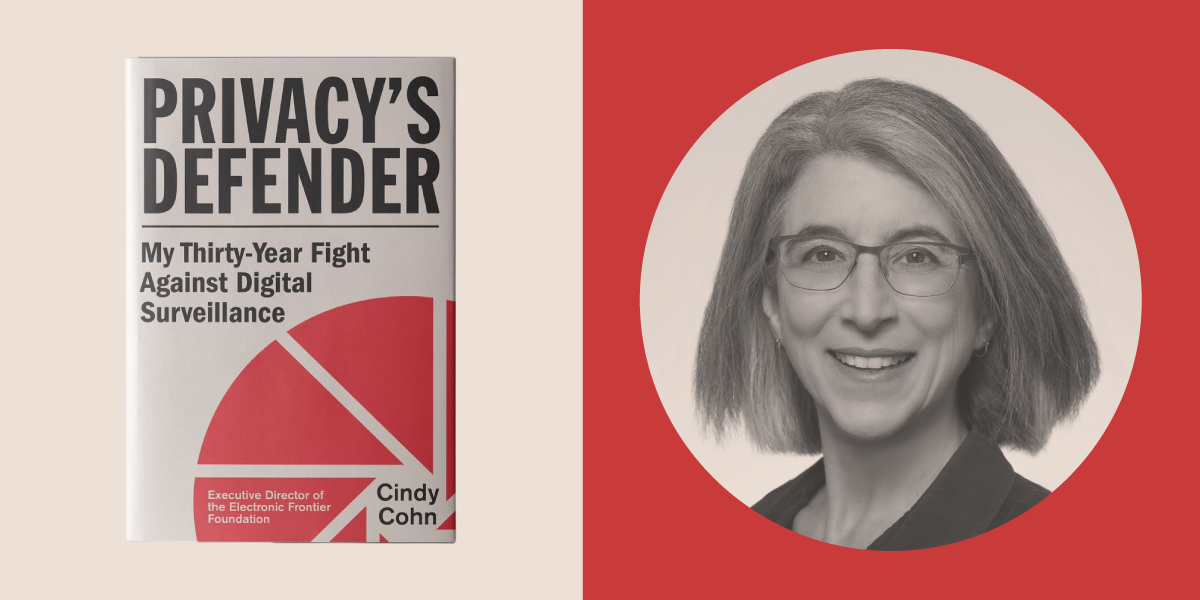
In Privacy’s Defender: My Thirty-Year Fight Against Digital Surveillance (MIT Press), EFF Executive Director Cindy Cohn weaves her own personal story with her role as a leading legal voice representing the rights and interests of technology users, innovators, whistleblowers, and researchers during the Crypto Wars of the 1990s, battles over NSA’s dragnet internet spying revealed in the 2000s, and the fight against FBI gag orders.
“Let’s Sue the Government” T-Shirt
 [
[
Sometimes our supporters call EFF a merch store with a law firm attached because our stickers, hoodies and shirts are so well known. Our “Let’s Sue the Government” shirt tells people: When your rights are at risk, you don’t stay quiet.
EFF’s History
In early 1990, the U.S. Secret Service conducted raids tracking the distribution of a document illegally copied from a telecom company’s computer; one of those targeted was an Austin, TX publisher named Steve Jackson, whose computers were seized but later returned without any charges filed. Jackson’s business had suffered, and he discovered that the government had read and deleted his customers’ emails. He sought a civil liberties organization to represent him for this violation of his rights, but no existing organization understood the technology well enough to grasp the free speech and privacy issues at hand.
But a few well-informed technologists did understand. Mitch Kapor, former president of Lotus Development Corp.; John Perry Barlow, a Wyoming cattle rancher and lyricist for the Grateful Dead; and John Gilmore, an early employee of Sun Microsystems, with help from Apple co-founder Steve Wozniak, decided to do something about it – and so the Electronic Frontier Foundation was born in July 1990. The Steve Jackson Games case turned out to be an extremely important one for the early internet: For the first time, a court held that electronic mail deserves at least as much protection as telephone calls.

EFF’s original logo, in use from 1990-2018
EFF continued to take on cases that set important precedents for the treatment of rights in cyberspace. In our second big case, Bernstein v. U.S. Department of Justice, the United States government prohibited a University of California mathematics Ph.D. student from publishing online an encryption program he had created. Years earlier, the government had placed encryption on the United States Munitions List, alongside bombs and flamethrowers, as a weapon to be regulated for national security purposes; our lawsuit established that written software code is speech protected by the First Amendment, and the further ruled that the export control laws on encryption violated Bernstein’s rights by prohibiting his constitutionally protected speech. Now everyone has the right to “export” encryption software—by publishing it on the Internet—without prior permission from the U.S. government.
Since then we’ve fought against government and corporate abuses of our Constitutional rights, on issues including warrantless wiretapping by intelligence agencies, the panopticon of street-level surveillance that seeks to track everything we do, and the corporate surveillance that turns our clicks into their commodity, as well as issues of antitrust and intellectual property, artificial intelligence, cybersecurity, and much more. We are lawyers, technologists, activists, and lobbyists who work every day for the privacy, security and dignity of all who use technology – and if you use technology, this fight is yours, too.
EFF’s Greatest Hits
While many early battles over the right to communicate freely and privately stemmed from government censorship, today EFF is fighting for users on many other fronts as well.
Today, certain powerful corporations are attempting to shut down online speech, prevent new innovation from reaching consumers, and facilitating government surveillance. We challenge corporate overreach just as we challenge government abuses of power.
We also develop technologies that can help individuals protect their privacy and security online, which our technologists build and release freely to the public for anyone to use.
In addition, EFF is engaged in major legislative fights, beating back digital censorship bills disguised as intellectual property proposals, opposing attempts to force companies to spy on users, championing reform bills that rein in government surveillance, documenting police technology and where it’s used, helping users protect themselves from surveillance, and much more.
Learn more about some of EFF’s most impactful work— Download a PDF of our new catalog, “Now That’s What I Call Digital Rights!